A Shared Whisper Across Time
There’s something powerful about realizing that long before missionaries crossed oceans, long before the Bible was translated into English, long before the name “Yehoshua” or “Christ” ever reached the shores of North America, the Creator was already speaking. He was already walking amongst them. Already breathing life into people who had never heard His name but somehow knew His spirit. When you look at Indigenous traditions and the Christian story side by side, you start to see that the distance between them isn’t as wide as people assume. In fact, the parallels are so strong that it almost feels like two branches growing from the same ancient root.
Both worldviews begin with the same truth:
The world is alive because the Creator breathed life into it.
In Scripture, that breath is called Ruach — the wind, the Spirit, the invisible force that animates everything. Indigenous peoples describe the same reality through the Great Spirit or the Great Mystery, a presence that moves through the land, the sky, the animals, and the people. Neither tradition sees creation as dead matter. Neither sees the world as a machine. Both see it as a living, breathing reality held together by the Creator’s own essence. When the wind moves through the trees, when the river flows, when the fire crackles, both traditions hear something more than sound. They hear the breath of God.
Because of that breath, both traditions see the world as unified. There’s no hard line between physical and spiritual. There’s no “ordinary” world and “holy” world. Everything is connected because everything comes from the same source. The Hebrew writers understood this deeply — “In Him we live and move and have our being.” (Acts 17:28).
Indigenous peoples expressed the same truth through kinship: humans, animals, land, and sky are all relatives because they share the same Creator. This isn’t romanticism. It’s not primitive thinking. It’s a worldview that recognizes that the sacred is woven into the fabric of reality. God is not far away. He is not silent. He is not absent. He is present in the world He made, sustaining it moment by moment.
The First Echo of the Creator
The deeper you look, the more you see that both systems are built on relationship. In the Christian story, God forms a covenant — a sacred bond — with His people. It’s not just a contract. It’s a relationship that shapes how humans live. How they treat one another, and how they honor the world around them. We are to be the caretakers of the garden, as directed to Adam in the beginning. We are to watch over all things for they are gifts from the creator.
Indigenous traditions mirror this through reciprocity and responsibility. Life is a gift, and gifts must be honored. Creation is sacred, and sacred things must be treated with respect. Humans have a duty to walk in balance, to live in harmony, to recognize that their actions ripple outward into the world around them. That we are to walk in kinship with the land. From the trees to the animals, all is connected. All is sacred.
Both traditions insist that morality isn’t random. It flows from the character of the Creator. Both insist that life is sacred. Both insist that humans are accountable to the One who made them.
This is where the beauty really hits:
Indigenous people had a genuine, authentic awareness of God long before they knew His name.
They weren’t godless. They weren’t wandering in darkness. They weren’t worshiping lies. They were responding to the revelation they had — the Creator’s voice in the wind, His presence in the land, His whisper in their spirits. Scripture itself says God never left any nation without a witness. Creation testifies. Conscience testifies. The Spirit moves where He wills it. The Great Spirit isn’t a rival to the Holy Spirit. The Great Spirit is the early echo — the first language — of the same divine presence Christians recognize as the Spirit of God.
God was with them.
God was speaking to them.
God was drawing them long before Christianity ever arrived.
The Spirit Who Moves Through All Things
When you look at the parallels between Indigenous spirituality and the Christian story, everything eventually circles back to the Holy Spirit. Not as a vague force, not as a poetic metaphor, but as the living presence of God who moves closest to creation. Protestants understand the Trinity as one God in three parts — connected, unified, but also distinct. Christ walked the earth as a man while still being apart of God. The Father reigns as the eternal source. And the Holy Spirit is the breath of God, the One who moves through the world, sustaining life itself. All extensions of one being but in our relativity they appear as separate.
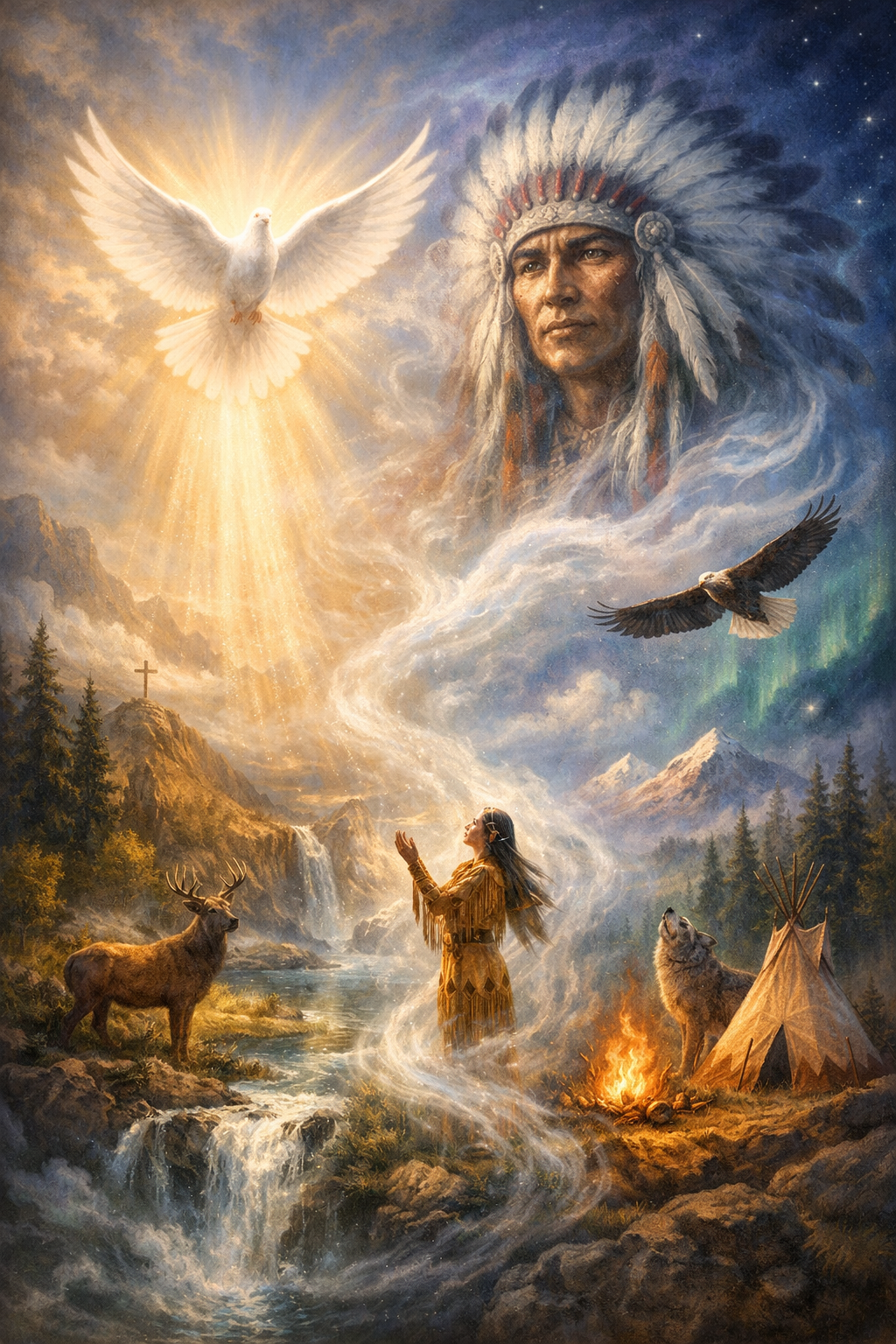
That’s why the Holy Spirit resonates so strongly with Indigenous traditions. The Great Spirit, the Great Mystery, the life-force that flows through nature. These ideas echo the same truth Christians see in Scripture. The Spirit is the breath that fills human lungs, the presence that stirs the wind, the life that pulses through creation. Spoken by nations separated by time and space. He may go by many names “Mother Nature”, “Pachamama”, “Gia”, “Jord”… All the names point to the same spirit. He is the One who gives nature its life. He is the Great Spirit of the natives, He is the Holy Spirit of the Christians. He is the divine presence that is spoken in all languages. For he is in all nations. For he is in all things.
Indigenous peoples weren’t far from God — they were responding to the same breath of life that Christians recognize today. The Spirit has always been here, moving, guiding, and drawing humanity toward the One who made them. The Spirit that so many people of this earth feel. The connection to each other and our surroundings, is the part of God who walks closest to His creation.
And this is the beauty of it all; God was with people long before they knew His name. The Holy Spirit was already whispering in the wind, already stirring hearts, already revealing the Creator through the world He made. From the moment humanity opened its eyes, we knew he was with us.
(more information on shared culture and theology can be found in the Faith Family Tree book, available on Amazon)