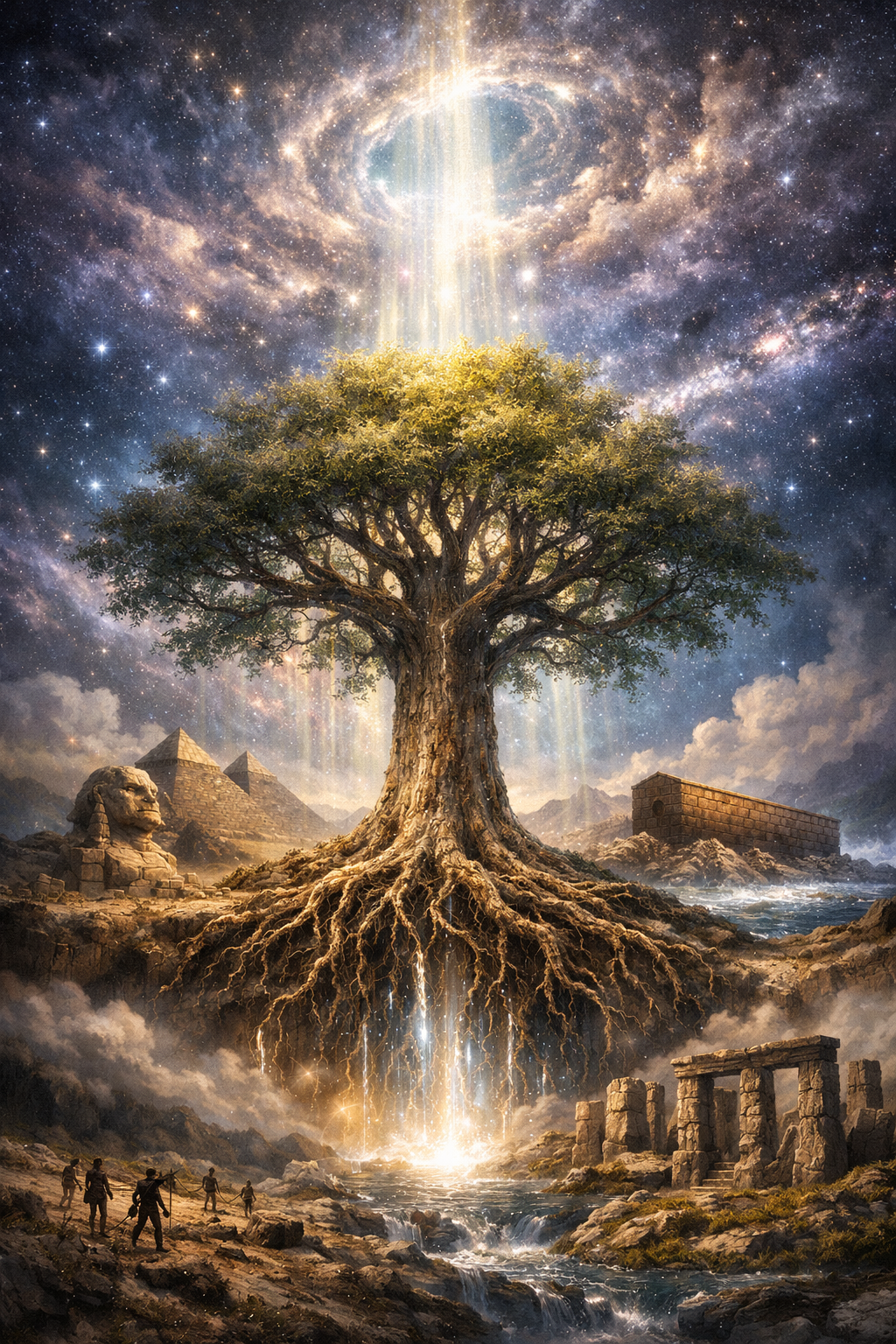
{The FFT book is available on Amazon. Here is a taste of the Tree that connects all Faith. Everything in this blog is copyrighted by Jared Shaw.}
Chapter 1
Origins of Theology: Ancient Judaism and the Historical Foundations of Faith
Myths, Legends, and History
Through the lenses of archaeology, anthropology, comparative religion, and mythology, we build a bridge between faith and academia.
Here, we form and test the hypothesis: ancient Judaism is not merely a singular tradition, but the theological and spiritual trunk from which numerous branches—Christianity, Islam, Zoroastrianism, the pantheons of the old world, and the creeds of the new have diverged.[1]
As we follow this narrative, each element from Mount Sinai’s mineral secrets, the mystery of the Dead Sea Scrolls, the persistent rumors of the Ark of the Covenant and Noah’s mountain, the wounds of Babel, the global flood myths, and the uncanny alignment of global pyramids, we discover that myths and religion are not fables, but facts—living memos from the earliest ages of human cultural evolution.
We will examine contrary thoughts and compare viewpoints from multiple cultures and theories from across human history. We will dive into Egypt and explore where its knowledge and ancestors may have come from. We will look at the natives and their entanglement with the Norse. We will study pagan convergence and where our festivals originate. Though we will be looking through the perspective of the Judaic/Christian timeline, we will also compare the thoughts of those on the outside. At the end, it will be the open mind that survives the crucibles of history and faith.
Introduction
The Tree at the center of religion derives from Judaism and the branches of faiths across history. Ancient Judaism may be the theological and cultural source of global religions. All cultures and religions may derive from one singular point in history.
The possibility of a precursor civilization, as told through the Book of Genesis, could be the focal point for world religious and cultural diversity. We can look at the story of Noah and the Flood, a story found in other religions and cultures across the world, which directly flows into the story of Babylon and the Tower of Babel. If we set this point outside the theology of the Bible and look at it as a focal point in history, we can see the roots of the tree of faith as it begins to grow and diversify.
Like the great conundrum of the Galápagos’ evolution, we may be able to pinpoint the first seeds of religion, watching how they grew and spread. On those great islands, we see how one species (like the finch) can have a wide variability. Though they all share a common ancestry, they become their own segregated groups with unique backgrounds and evolutionary traits, much like the origins of human civilization.
Here we will examine the family tree of faith, from its roots to its canopy and all the parts that make it.
[1] Gerson D. Cohen, “Judaism,” Britannica, February 1, 2026, https://www.britannica.com/topic/Judaism.
Chapter 2
The Trunk, Ancient Judaism and Its Branching
The Bronze Age World. Nomads, city-states, and unifying narratives. Judaism emerges from the cradle of civilizations: Canaan, Egypt, and Mesopotamia. Before Moses, before the written Law, there were the wandering patriarchs. Abraham, Isaac, and Jacob, whose lives are transmitted in the roots of oral tradition and eventually, in the Hebrew Scriptures. This era, the “pre-Mosaic period,” saw the shaping of a collective consciousness that would crystallize around a single God. Tribal stories, local gods, and fertility rites dominated the landscape, but Israel’s spiritual trajectory points toward an unprecedented vision: “monotheism.”
Mosaic Revolution
Law, Covenant, and Ethical Monotheism. First, there was Adam. Then came Noah, his descendant. After the floods, we see Noah and his lineage lead to Abraham. Abraham is where proto-Judaism finds its voice. Then came Moses, and through the Exodus, the first writings of our faith began.
It is with Moses and his encounter with the burning bush atop a mountain, later called Sinai, that Judaism comes sharply into focus. Here, in historical memory or perspective theology, a people hear the voice of God and receive the Law: “I am that I AM” (Exodus 3:14). The content and method of Sinai’s revelation, preserved in the Torah, form the spine, not only of later Judaism but also of Christian and Islamic tradition.
At the same time, we have the story of Zarathustra arising a thousand miles away, around modern-day Iraq, and shortly after, a faith that correlates directly with Judaism arises. What time and distance separated the two? We cannot accurately point that out. However, we can see that both faiths are developing in a world that recognizes one God rather than many. So, to the world, these religions are heresy. Yet they beg the question, “How did the Persian ancestry have their own Moses?” How do these stories correspond in history, and where is their connection?
Moses freed his people from the rule of the Egyptians and led them on the path to the land of milk and honey. Here, we see the descendants of Abraham finally take their rightful home in the lands now known as Israel.
The people of Moses grow and integrate with the people of the Persian empire. Those with their own Moses, and in the years to come, we see stories correlating with one another in separate lands. Stories of God and man, the Creator and the antagonist. As the Jewish faith develops through song, culture and scribes, we see a blossoming revolution. Monotheism spreads.
Yet during the Roman occupation, we can see how one faith can split into many. One messiah, one prophet. Both followers of Moses, yet separated by nearly 500 years and differing beliefs. Allowing us to see a new age branching of a singular tree.
Jewish Divergence
The birth of two faiths: Christianity and Islam, from Jewish Roots.
Christianity
Christianity is deeply rooted in Judaism. During the BC-AD transition, Jesus of Nazareth lived and taught as a Jew, and the earliest Christians continued to attend synagogues and honor the Law of Moses. Over time, Christianity slowly grew from a Jewish sect into a separate faith, with both shared traditions and growing differences. Paul’s letters and the Gospels reiterated and expanded key Jewish ideas, like covenant, salvation, and the Messiah. As we look into the context of Roman rule, we use the Hebrew Bible (Tanakh) as both a starting point and a guide. We can highlight how this period was marked by blending traditions and complex changes. Christian theology began to focus more on universal access to God, moving beyond Jewish rituals while upholding Judaism’s strong ethical values and belief in one God.
Jesus, or the original Hebrew Yeshua or Yehoshua (changed in Greek translations to Iesous “ee-yay’-soos”), means the salvation of God, God saves, or God delivers, depending on the emphasis. “Christ,” originating from Greek as Christos, is a title meaning “the Anointed One,” whose name translates to “God delivers the anointed one.” Jesus Christ of Nazareth is who Christians believe to be the promised Messiah prophesied in the Hebrew Scriptures. Christians are those who follow the teachings, life, and example of Jesus, regarding Him as the central figure who bridges the divine and human realms. The core teachings of Christianity emphasize love, compassion, forgiveness, and the pursuit of justice, all rooted in the commandment to love God and one’s neighbor as oneself. Christians uphold that through Jesus’s life, sacrificial death, and resurrection. Through him, humanity is offered salvation, a restored relationship with God and the hope of eternal life. Over centuries, Christian doctrine has developed into various branches and denominations, but the central teachings of Jesus remain the same. Humility, mercy, and the transformation of the heart through faith and grace.
Islam
Shared Waters, Separate Streams. Islam, which arose in the 7th century CE, is equally indebted to Judaism. The Quran regards Moses as the most frequently mentioned prophet, identifies with Israelite history, and sees itself as the completion of the Abrahamic tradition. Islamic prayer rituals and legal codes mirror Jewish practice in many aspects, and the concept of “People of the Book” (Ahl al-Kitab) recognizes Jews and Christians as spiritual kin.[1]
The Prophet Muhammad, regarded as the final messenger in Islam, began preaching in Mecca in the early 7th century. Islam’s roots are intertwined with both Judaism and Christianity, yet Muhammad’s revelations introduced a new path, emphasizing direct submission to one God (Allah), community solidarity, and a fresh set of laws and spiritual principles. While acknowledging the prophets and scriptures of Judaism and Christianity, Islamic teachings diverged with the Quran’s unique narratives and guidance, forming a faith distinct from its Abrahamic siblings. Showing the vast differences between two kin faiths.
Divergence
Islam has some major differences from Judaism, especially when it comes to prophets, holy books, and religious laws. Where Christianity continues the knowledge passed down by Judaism almost exactly, with a few laws acknowledged but changed by Christ. Islam has a few contradictory viewpoints against Christianity. Specifically, around the theology that Christ was a great prophet, but not the Messiah. They overturned a lot of the old Jewish teachings and developed a new viewpoint alongside the last prophet Muhammad and his teachings.[2]
Throughout history, the two faiths have had times of rich cultural exchange, but also moments of extreme conflict and competition. As Jewish, Christian, and Islamic ideas spread and mixed across regions such as the Mediterranean, Persia, Asia, North Africa, and Spain, they influenced one another in significant ways. This shared history shows how the three Abrahamic religions grew together (sometimes in harmony, sometimes in tension) and remained connected through history.
Branches of the Tree
We can view the connectivity of faith that emerged over the last two millennia as a focal point that allows us to look further back into history—possibly examining how the origins of ancient faiths, myths, and legends may have derived from a single original religion and surrounding culture. The Crusades in the Middle East show how religions that started from the same roots can end up clashing in violent and hostile ways. Separation by time, geography, language, and culture demonstrates how two elements of a shared narrative can eventually come into conflict.[3]
Where do these diverging and converging faiths come from? Where’s our proof of history and collaboration in archaeology? Both the Islamic and Christian faiths come from Judaism. They follow their texts and keep their tablets. Information is passed down from one generation to the next. Even proven through the discovery of the Dead Sea Scrolls and the archaeology that may have uncovered Noah’s boat. Even pieces of the great mountain where fire rained down from the heavens. We begin to see the protective coating of the Jewish faiths.[4]
[1] “Islamic-Jewish Relations,” Wikipedia, https://en.wikipedia.org/wiki/Islamic%E2%80%93Jewish_relations.
[2] Hans Herman Henrix, “Paul at the Intersection between Continuity and Discontinuity – On Paul’s
Place in early Judaism and Christianity as well as in Christian-Jewish Dialogue Today,” PDF, https://theo.kuleuven.be/uploads/Henrix_-_Paul_Between_Continuity_and_Discontinuity.pdf. Accessed February 27, 2026.
[3] Katharina Heyden and David Nirenberg, “Co-Produced Religions: Judaism, Christianity, and Islam.” Harvard Theological Review 118, no. 1 (2025): 159–80. https://doi.org/10.1017/S0017816025000094.
[4] “Christianity vs. Judaism,” Diffen, https://www.diffen.com/difference/Christianity_vs_Judaism. Accessed February 25, 2026.