(All rights reserved and copyrighted by Jared Shaw)
New book Idea
Concept Discussion
There are questions that sit at the crossroads of theology and philosophy — questions that don’t fit neatly into sermons or devotionals, yet shape the way believers understand God, themselves, and the moral life. One of the most pressing is the fire‑starter for this potential book: Does God give you credit for trying to do the right thing, even when your heart isn’t in it? This question exposes the tension between intention and action, between the heart and the hands, between what we feel and what we choose. It forces us to confront the uncomfortable truth that much of Christian obedience is lived in the gap between desire and discipline.
This question opens the door to many others. Is reluctant obedience still obedience? Is forced kindness still kindness? Does God value the struggle itself? Is it hypocritical to do the right thing when your emotions resist?
These are not abstract puzzles — they are the lived reality of every believer who has ever forgiven without feeling forgiving, prayed without feeling spiritual, or resisted sin without feeling strong. The book would explore these tensions not as failures, but as the very terrain where sanctification unfolds.
From this starting point, the book could branch into broader philosophical conundrums: the nature of goodness, the psychology of moral intention, the formation of virtue, the meaning of sincerity, and the role of divine grace in human effort. It could examine whether moral value lies in the act, the motive, or the struggle. It could explore how Scripture holds together both the command to obey and the call to love God with all the heart — even when the heart is divided.
This project would not be a cold academic dissertation. It would be a book for believers who want to think deeply about faith without losing the warmth of devotion. It would wrestle with the questions Christians actually live: Does God judge the outcome or the effort? Does He honor the attempt? Can obedience shape desire? Can doing good when you don’t feel good still be good in the eyes of God? These questions form the backbone of a book that blends theology, philosophy, psychology, and Scripture into a single, honest conversation about what it means to follow God in a broken world with a broken heart.
This book would be less of an answer and more of a question. Together we could unfold the question that I have asked for years. If my heart is broken but my body is willing, can God forgive my absence of love as I give to the needed or help a friend? Do you have to have a loving heart to be a disciple of Christ? Or is picking up the cross and fallowing the path enough for God to bless our actions?
Possible 5‑Part Outline
Part I — The Divided Heart
Exploring why humans often know the right thing before they desire it, and how Scripture describes the inner conflict between flesh and spirit (Romans 7:15–25).
Part II — The Nature of Goodness
What makes an action “good”? Is goodness measured by intention, outcome, or obedience? Includes reflections on Micah 6:8 and Matthew 5–7.
Part III — God’s View of Human Effort
Does God honor the struggle? Examining the parable of the two sons (Matthew 21:28–31), the widow’s mite (Mark 12:41–44), and the idea of “faithfulness in little things.”
Part IV — Sanctification and the Slow Formation of Desire
How obedience shapes the heart over time. The role of discipline, habit, and the Spirit’s work (Galatians 5:16–25; Philippians 2:12–13).
Part V — Living the Tension with Hope
Practical reflections on doing good when you don’t feel good, trusting God with imperfect motives, and embracing grace as the engine of transformation (Psalm 51:10; 1 John 3:20).
Summary of What the Book Would Unfold
Philosophy of Christian Theology would be a book for believers who want to think deeply about the moral and spiritual life without losing the warmth of devotion. It begins with a simple but unsettling question: Does God give you credit for trying to do the right thing, even when your heart isn’t in it? This question becomes the doorway into a larger exploration of the human condition — the divided heart, the fractured will, and the tension between what we know is right and what we actually desire.
The book would unfold by examining the nature of moral intention. Philosophers have long debated whether goodness lies in the act itself or in the motive behind it. Scripture complicates the question by affirming both: God looks at the heart (1 Samuel 16:7), yet He also commands obedience even when the heart lags behind (John 14:15). The book would explore this tension, showing how reluctant obedience is. Not hypocrisy but often the first step toward genuine virtue.
From there, the book would move into the nature of goodness. What does it mean to “do justice, love mercy, and walk humbly with God” (Micah 6:8) when your emotions resist? Is a good deed still good when performed out of duty rather than desire? Jesus’ parable of the two sons (Matthew 21:28–31) suggests that action matters — the son who obeyed, even reluctantly, did the will of the Father. This section would explore how Scripture values both intention and action, and how the two interact in the formation of character.
The third movement of the book would examine God’s perspective on human effort. Does God honor the struggle? The widow’s mite (Mark 12:41–44) suggests He does. Paul’s confession in Romans 7 reveals that God understands the inner war believers face. Philippians 2:12–13 shows that God works within human effort, not apart from it. This section would argue that God sees the attempt, the wrestling, the desire to desire Him — and that He counts it as faithfulness.
The fourth section would explore sanctification as a slow, often painful process in which obedience shapes desire. The fruit of the Spirit (Galatians 5:22–23) grows over time, not instantly. Discipline becomes the soil in which love eventually blooms. This section would encourage readers that doing the right thing when they don’t feel like it is not spiritual failure — it is spiritual formation.
Finally, the book would conclude with hope. Psalm 51:10 reminds us that God creates a clean heart; we do not manufacture one. 1 John 3:20 assures us that God is greater than our hearts. The book would end by affirming that God honors imperfect obedience, values the struggle, and transforms the heart through the very acts of faithfulness we offer Him — even when our emotions lag behind.
Conclusion
This book would open with the hard ball question. Its meant to wound you, as soldiers are broken down in bootcamp, here I will break down the walls that gourd our hearts. We will look inwards at our broken pieces and start to understand them through scripture, psychology, and philosophy.
Some answers may arise, but this book would be more of a possibility over a certainty. In its mists we will learn to form better habit’s for the broken hearted. We will look deep into gods words and mans understanding of the mind and moral action. Here will be the training grounds for the mind.
In the end, the book will not say yes or no. Yet it will be a branching stream, flowing in a multitude of directions for you as the reader to decide what your heart needs, wants and desires.
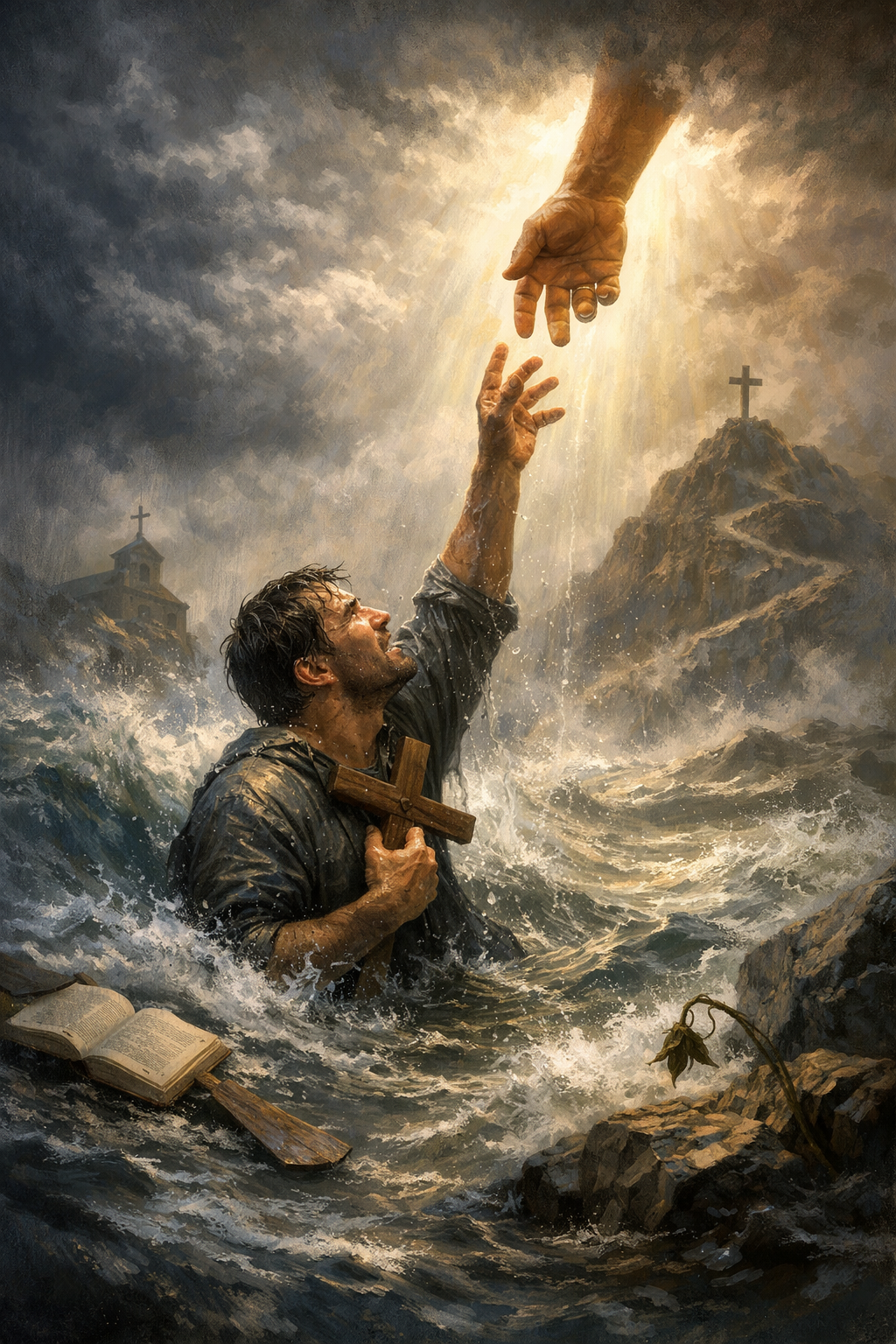
Maybe I can help the drowning, Maybe you need a paddle to steer with. Maybe you need a plug for the leak in your boat. Or maybe you are like me, one hand stretched upward head under water with the last breath slipping out begging for someone to reach out and save you.
If this book is desirable to you as a reader, then send me a message in the contact page or on social media. Give me some ideas, supports or counter arguments. Lets start a discussion and see if this book is worth it.