


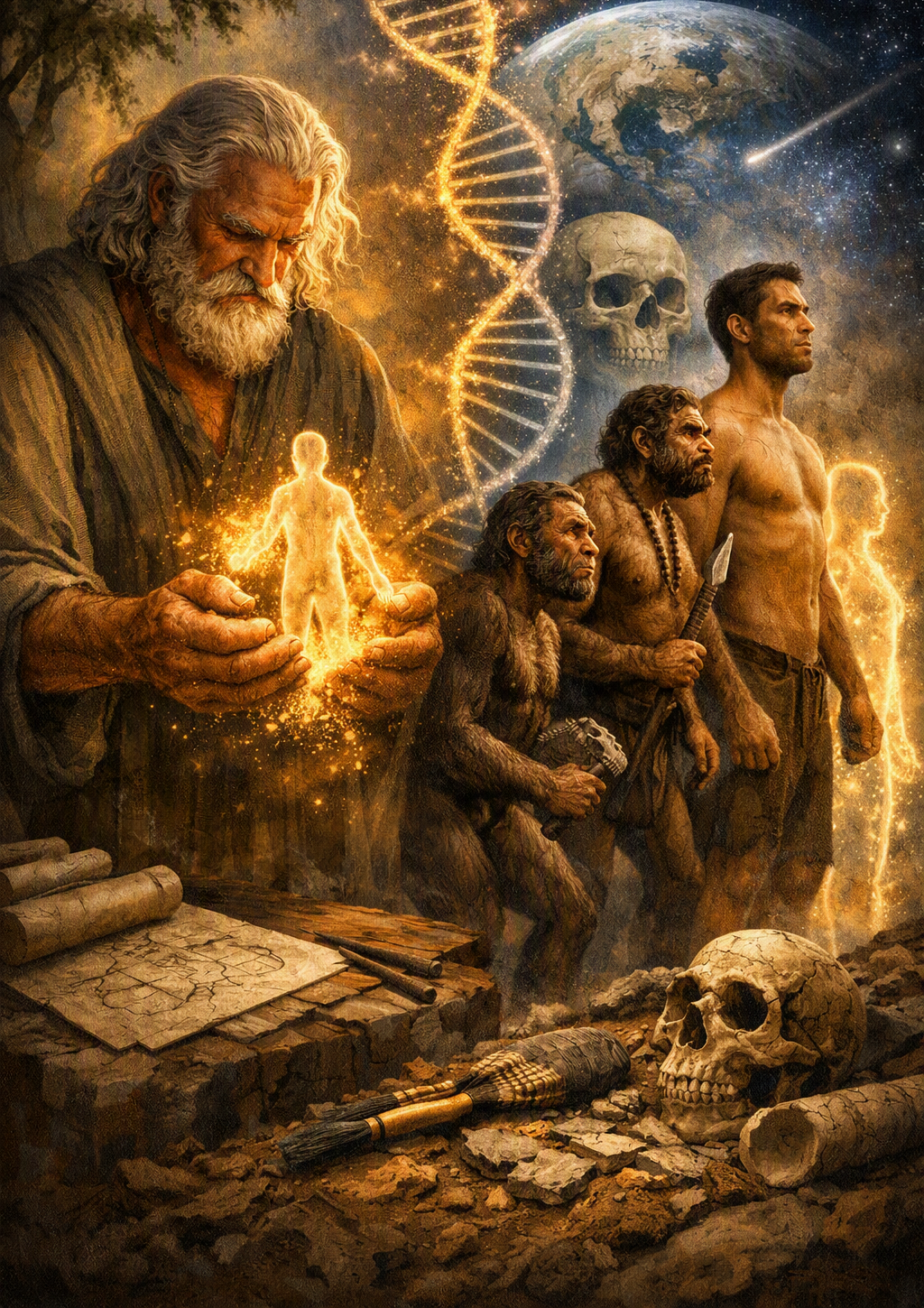
Genesis & Genetics
Was Adam the First, or the Final Masterpiece?
For centuries, there has been a debate that forces people to pick a side: Science or Faith?
On one side, we have the Genesis account of creation. On the other, we have archaeology, carbon dating, and the fossil record showing distinct variations of hominids like Neanderthals. But what if these two realities aren’t actually at war? What if, as people of both faith and logic, we are just looking at the timeline from the wrong perspective?
Today, let’s explore a different view of Genesis—one where science doesn’t limit God, but instead highlights the incredible, deliberate process of His creation.
1. The Master Craftsman’s Process
Anyone who has ever built something from scratch—whether framing a structure, fabricating a custom design, or engineering a new tool—knows that the final product is rarely the very first attempt. You test materials. You build prototypes. You refine the design until it functions perfectly.
What if God, the ultimate Creator, worked in a similar way?
If we look at hominid genealogy (like Homo neanderthalensis) or even the era of the dinosaurs, we don’t have to view them as mistakes or contradictions to the Bible. Instead, we can see them as steps that led to perfection. Like a scientist perfecting an experiment or a master potter molding clay, there were prior iterations. God was setting the stage, preparing the environment, and refining the biological vessel.
Adam wasn’t necessarily the first attempt at a human-like creature. Adam was the final, perfected product.
2. The Breath of Life: What Made Adam Different?
If other hominids existed before Adam, what makes the Genesis account so special? The answer is found in
Genesis 2:7
“Then the Lord God formed a man from the dust of the ground and breathed into his nostrils the breath of life, and the man became a living being.”
Before Adam, biological creatures lived and died. But that death had no spiritual meaning—it was simply the non-sentient cycle of nature. There was biology, but there was no spirit.
Adam was the first creature made in the image of God. When God breathed into Adam, He wasn’t just giving him oxygen; He was giving him a soul.
This completely reframes how we view the “fall of man.” Once a creature had a soul, it was designed to live in eternal communion with God. Therefore, when Adam sinned, spiritual death entered the world. Sin is the only thing that can kill a soul, and that is why Adam’s choice in the garden was so catastrophic. It wasn’t the introduction of biological end-of-life; it was the introduction of separation from God.
3. Solving the DNA Mystery (And Cain’s Wife)
This theory also beautifully bridges a major gap in the atheist debate regarding modern DNA. Science shows that many modern humans carry traces of Neanderthal DNA. If Adam and Eve were the absolute biological beginning of everything walking on two legs, this wouldn’t make sense.
But if other, soul-less hominid variations existed outside the Garden of Eden, the puzzle pieces snap together.
When Cain is exiled to the land of Nod and finds a wife (Genesis 4:16-17), he didn’t necessarily marry a direct sibling. His wife could easily have been from one of these prior hominid variations—a Neanderthal or similar biological relative. This seamlessly explains the introduction of “corrupted genetics” into the human bloodline and why we still see those genetic markers in our DNA today.
4. Why Isn’t This in the Bible?
A fair question to ask is: If this is true, why didn’t Moses just write it down in Genesis?
We have to remember what the Bible is, and just as importantly, what it isn’t. The Bible is not an exhaustive encyclopedia of planetary history, carbon dating, or biological evolution. It is the story of our salvation.
There are many things we know existed historically that the Bible glosses over or leaves out entirely. Look at the extra-biblical texts like the Books of Enoch or the writings of Solomon, which dive deep into the Nephilim, spiritual warfare, and ancient history. Those details were left out of the canonical Bible not necessarily because they were completely false, but because they aren’t essential to the core message: Man fell, and God sent Jesus to redeem us.
Just because something isn’t detailed in the Bible doesn’t mean it isn’t true. God gave us a spirit to connect with Him, but He also gave us a brain to observe His creation. We don’t have to turn off our logic to read our Bibles.
For seekers of knowledge and those who thrive for deeper meanings, usually applying science to gods mysteries makes the pursuit of understanding far more meaningful.
“It is not our place to know all, however it is our duty to contemplate everything.” – Jared Shaw
Reflection Questions for the Week:
-
How does viewing God as a “Master Builder” refining His creation change the way you read the first chapter of Genesis?
-
Does separating “biological death” from “spiritual death” help make sense of the timeline of the earth?
-
How can we use logic and scientific discovery to strengthen our faith, rather than letting it cause doubt?
If you have questions or theories, please reach out.
Leave a Comment: